
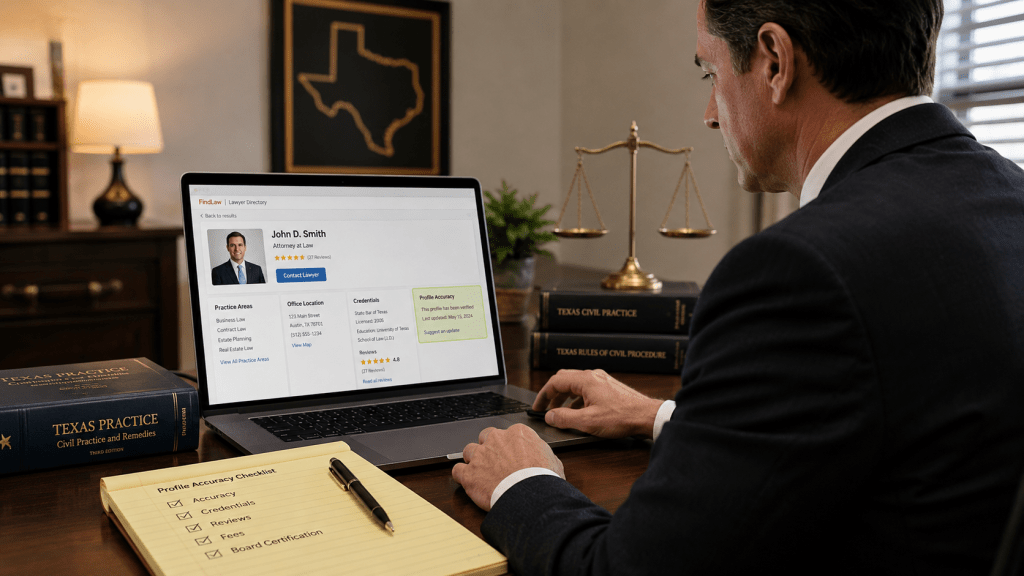
Online attorney profiles are often one of the first places potential clients look when they need legal help. A profile may include a lawyer’s name, firm, location, practice areas, credentials, biography, reviews, contact information, consultation options, and links to a law firm website.
That visibility is useful, but it also creates responsibility.
For Texas attorneys, online directory profiles should be accurate, current, and careful. A profile that exaggerates experience, implies guaranteed results, misstates credentials, uses unverifiable comparisons, or creates confusion about paid placement can create professional responsibility concerns.
This guide explains practical ways Texas attorneys can maintain online directory profiles that are useful to the public while avoiding common ethics and advertising risks.
This article is for general informational purposes only and is not legal ethics advice. Attorneys should review the Texas Disciplinary Rules of Professional Conduct and consult appropriate ethics resources or counsel about specific questions.
Why Directory Profile Accuracy Matters
A directory profile may seem simple, but it can influence how a potential client evaluates legal help. A person may rely on profile information to decide whether to call, schedule a consultation, or compare attorneys.
That means profile details should not be treated casually.
Under Texas Rule 7.01, a lawyer may not make or sponsor a false or misleading communication about a lawyer’s or law firm’s qualifications or services, and communications about legal services must be truthful and nondeceptive. The rule also addresses communications that omit facts needed to make the statement as a whole not materially misleading or that create unjustified expectations about results.
For directory profiles, this principle applies to the details users are most likely to notice:
- Practice areas;
- Office locations;
- Attorney names;
- Licensing status;
- Years in practice;
- Fee descriptions;
- Consultation availability;
- Board certification claims;
- Awards and recognitions;
- Reviews and testimonials;
- Case results;
- Featured or sponsored placement;
- Statements about responsiveness or availability.
A conservative profile is usually better than a profile that tries to sound more impressive than it can support.
Treat an Online Profile as a Professional Communication
An attorney profile is not just a biography. It is also a communication to the public about legal services.
Texas Rule 7.01 states that the rule governs communications about a lawyer’s services, including advertisements and solicitation communications. The same rule defines “advertisement” and “solicitation communication” in the context of communications substantially motivated by pecuniary gain.
For practical purposes, Texas attorneys should assume that public-facing directory content deserves the same careful review as website copy, social media advertising, landing pages, print ads, and other marketing materials.
A sound internal review should ask:
- Is every statement accurate?
- Can we verify every credential?
- Could a reasonable person misunderstand this claim?
- Does the profile imply a result we cannot promise?
- Does the profile suggest a specialization or certification that has not been verified?
- Does any review language create unjustified expectations?
- Is paid placement clearly distinguishable from endorsement?
- Is the responsible lawyer and office location clear where required?
The goal is not to remove personality from attorney profiles. The goal is to avoid statements that could mislead the public.
Practice Areas: Be Clear Without Overstating
Practice area listings help users find attorneys who may handle their type of matter. But practice areas should be accurate.
For example, a profile may reasonably list areas the attorney handles, such as:
- Family law;
- Criminal defense;
- Personal injury;
- Probate;
- Estate planning;
- Business law;
- Real estate law;
- Civil litigation;
- Immigration;
- Employment law.
The problem arises when a profile overstates focus, experience, or specialization.
Safer wording:
- “Handles family law matters.”
- “Represents clients in criminal defense cases.”
- “Assists with estate planning and probate.”
- “Represents businesses in contract disputes.”
Riskier wording:
- “The best family lawyer in Texas.”
- “Guaranteed to win your case.”
- “Texas’s top criminal law specialist.”
- “The most successful injury firm in the state.”
Under Rule 7.02, a lawyer who advertises may communicate that the lawyer does or does not practice in particular fields of law, but statements about certification or specialization require care.
A directory profile should help clients understand what the attorney does without creating unsupported superiority claims.
Board Certification Claims Must Be Verified
In Texas, “Board Certified” is a specific credential. It should not be used casually.
The Texas Board of Legal Specialization states that it certifies attorneys in 28 areas of law and paralegals in 8 specialty areas. TBLS also provides a public tool to find a Board Certified lawyer by specialty area, name, city, county, or zip code.
On Texas Law Advisor, a lawyer should not be labeled as “Board Certified” unless that credential has been verified and approved. Conservative phrasing matters.
Acceptable if verified:
- “Board Certified in Family Law by the Texas Board of Legal Specialization.”
- “Board Certified in Personal Injury Trial Law by the Texas Board of Legal Specialization.”
Avoid if not verified:
- “Specialist.”
- “Certified expert.”
- “Board-certified style experience.”
- “Specialized in family law” if it could imply an official certification.
Texas Rule 7.05 includes an exemption category for communications containing only certain information, including areas of law in which a lawyer is certified by TBLS or by an organization accredited by TBLS. That does not mean certification language should be used loosely. It means the credential should be accurate, current, and properly stated.
Avoid Guarantees and Outcome Promises
Potential clients often want certainty. Attorneys cannot ethically manufacture certainty where none exists.
Avoid statements such as:
- “We will win your case.”
- “Guaranteed dismissal.”
- “Maximum recovery guaranteed.”
- “We always get results.”
- “No jail time guaranteed.”
- “We guarantee custody success.”
Legal outcomes depend on facts, evidence, law, judges, juries, opposing parties, agencies, deadlines, procedural rules, and many other variables. Even strong cases involve uncertainty.
Rule 7.01 addresses communications that are substantially likely to create unjustified expectations about results.
Safer alternatives:
- “We evaluate each matter based on its facts.”
- “We help clients understand their options.”
- “We represent clients in contested divorce and custody matters.”
- “We assist injured Texans with insurance claims and litigation.”
- “We defend clients facing misdemeanor and felony charges.”
A professional profile can be confident without promising a result.
Be Careful With Reviews and Testimonials
Reviews can help potential clients evaluate communication, professionalism, responsiveness, and client experience. But reviews can also create risk if they are manipulated, misleading, or presented without context.
Attorneys should avoid:
- Paying for fake reviews;
- Writing reviews on behalf of clients;
- Pressuring clients to leave positive reviews;
- Publishing confidential information in responses;
- Highlighting reviews that imply guaranteed results;
- Editing reviews in a way that changes meaning;
- Using review snippets that create unjustified expectations.
On Texas Law Advisor, reviews are moderated before publication. Moderation is designed to reduce spam, harassment, confidential information, manipulation, and irrelevant content. Reviews are not endorsements by the platform.
When responding to reviews, attorneys should be careful not to reveal confidential information. Even a defensive response can create a problem if it confirms representation, discusses facts, or reveals strategy.
Safer response:
“Thank you for your feedback. Our office takes client communication seriously.”
Riskier response:
“You lost because you refused to accept the settlement we recommended and failed to provide documents.”
A short, professional response is often better than a detailed public defense.
Paid Placement Must Not Look Like an Endorsement
Directories may offer paid visibility, including sponsored listings, featured profiles, Pro Spotlight placements, or advertising inventory. Paid placement can be legitimate, but it should be transparent.
Texas Law Advisor treats Featured and Pro Spotlight placements as paid promotional placements, not endorsements, rankings, or recommendations.
Attorney profile language should avoid implying that paid placement means:
- The attorney is “approved” as better than others;
- The platform recommends the attorney;
- The attorney is ranked highest by merit;
- The attorney is more qualified than non-featured attorneys;
- The attorney has been selected as “best.”
Safer wording:
- “Featured”
- “Sponsored”
- “Pro Spotlight”
- “Paid placement”
Riskier wording:
- “Top recommended attorney”
- “Best lawyer in this category”
- “Preferred by Texas Law Advisor”
- “Officially endorsed attorney”
Transparency protects both users and attorneys.
Keep Office Location and Contact Information Current
Outdated contact information frustrates users and may create confusion.
A profile should be reviewed regularly for:
- Office address;
- Phone number;
- Email address;
- Website URL;
- Counties served;
- Consultation availability;
- Languages spoken;
- Practice areas;
- Attorney status with the firm;
- Whether the attorney is accepting new matters.
Texas Rule 7.02 requires an advertisement of legal services to publish the name of a lawyer responsible for the content and identify the lawyer’s primary practice location.
Even when a specific directory field seems minor, inaccurate location information can mislead users who are trying to find local counsel.
Fee and Consultation Information Should Be Precise
Fee information can be useful to potential clients, but it should be clear and not overbroad.
Profiles may mention:
- Free consultation;
- Paid consultation;
- Flat fee availability;
- Hourly billing;
- Retainer required;
- Contingency fee for eligible matters;
- Payment plans, if available;
- Limited-scope services.
Texas Rule 7.02 comments recognize that permissible information may include the basis on which fees are determined, including prices for specific services and payment or credit arrangements.
Potential problems arise when fee statements are incomplete or misleading.
Risky:
- “No fee unless we win” on a profile that includes criminal defense or family law.
- “Free consultation” when the firm charges for most consultations.
- “Flat fee divorce” without making clear that it applies only to uncontested matters.
- “Affordable representation” without any context.
Safer:
- “Contingency fees may be available for eligible personal injury matters.”
- “Flat fees may be available for certain uncontested services.”
- “Consultation fees vary by matter type.”
- “Contact the firm to discuss fee structure and availability.”
Fee language should match the firm’s actual intake and engagement practices.
Case Results Require Extra Care
Some attorneys want to list verdicts, settlements, dismissals, acquittals, or other outcomes. This can be risky if the information is incomplete or creates unrealistic expectations.
If an attorney advertises the amount of a verdict and knows it was later reduced, reversed, or settled for less, Rule 7.01 requires the advertisement to state the amount ultimately received by the client with equal or greater prominence.
Practical considerations for case-result language:
- Include appropriate context;
- Avoid implying similar results are likely;
- Avoid cherry-picking in a misleading way;
- Do not disclose confidential information;
- Do not publish client-identifying details without proper authorization;
- Do not imply a result was achieved by a lawyer who did not handle the matter.
Safer general wording:
- “Represents clients in personal injury claims involving serious injuries.”
- “Defends clients in misdemeanor and felony criminal cases.”
- “Handles contested divorce and custody matters.”
If specific results are used, they should be carefully reviewed.
Advertising Review and Filing Considerations
Texas attorney advertising may involve filing requirements. The State Bar of Texas explains that most public marketing efforts must be submitted to the Advertising Review Committee unless exempt, and not all advertisements are required to be submitted.
Rule 7.04 states that, except as exempt under Rule 7.05, a lawyer must file certain advertisements or solicitation communications with the Advertising Review Committee no later than 10 days after dissemination. The rule also allows a lawyer seeking preapproval to submit materials at least 30 days before first dissemination.
The State Bar’s Advertising Review page also warns that if an attorney chooses not to submit an advertisement and is challenged, the burden rests on the attorney to demonstrate compliance; the page further notes possible fees and a fine for a non-exempt ad that was not filed.
Because exemptions can be technical, attorneys should review the applicable rules and determine whether a particular profile, advertisement, landing page, banner, or sponsored placement must be filed.
Website and Directory Content Are Not Always Treated the Same
Rule 7.05 identifies communications exempt from Rule 7.04 filing requirements unless they fail to comply with Rules 7.01, 7.02, and 7.03. The listed exemptions include certain law firm website information, social media or other media communications that do not expressly offer legal services and are primarily informational or resume-like, and communications containing only specified categories of information such as firm name, office address, practice areas, admissions, education, foreign language abilities, consultation fees, and TBLS-certified areas.
The State Bar’s materials also distinguish between compliance and filing. Even if something is exempt from filing, it still must comply with the advertising rules.
For attorney profiles, the practical point is simple: do not assume a directory listing is risk-free just because it is short, routine, or similar to a résumé.
Third-Party Directory Profiles Still Need Attorney Review
Some profiles are created from public business listing data. That data can be incomplete or outdated.
Texas Law Advisor’s directory may include imported public listing information. Attorneys may claim and update profiles only after login, credential upload, admin verification approval, and an active subscription for profile management.
Until a profile is claimed and verified, attorneys should understand that public listing information may not fully reflect current practice areas, office details, or availability.
After claiming a profile, attorneys should review:
- Name spelling;
- Firm name;
- Office address;
- Website;
- Phone number;
- Practice areas;
- Counties served;
- Biography;
- Credentials;
- Consultation details;
- Review settings;
- Contact form routing;
- Disclaimers.
A claimed profile should not simply be treated as a lead source. It should be treated as a public-facing professional communication.
Directory Inquiry Forms Should Avoid Confidential Intake Confusion
Attorney directory forms can help potential clients request contact, but they should not be framed as confidential legal intake unless that is accurate.
Texas Law Advisor should make clear that:
- It is not a law firm;
- It does not provide legal advice;
- Submitting an inquiry through the directory does not create an attorney-client relationship;
- Directory messages may not be confidential;
- Attorney-client relationships are created only by agreement between the user and the attorney or law firm.
Attorneys should also avoid profile language suggesting that submitting a general directory form immediately creates representation.
Safer wording:
- “Contact the firm to request a consultation.”
- “Submit an inquiry to ask about availability.”
- “The firm will review your request and respond if appropriate.”
Riskier wording:
- “Tell us everything confidentially here.”
- “Submit this form and we are your lawyers.”
- “Your case starts immediately when you click send.”
Clear boundaries protect users, attorneys, and the platform.
Avoid Misleading Badge or Logo Use
Badges and logos can be useful, but they can also mislead users.
Attorneys should avoid:
- Fake award badges;
- Unverified “top lawyer” graphics;
- Logos suggesting official government approval;
- TBLS logos without verification and authorization;
- Platform badges that imply endorsement;
- Badges that hide paid placement;
- Badges that suggest ranking by objective quality when the placement is paid.
A badge should clearly mean what it says.
For Texas Law Advisor, “Verified” should mean the attorney or firm has completed the platform’s verification process. “Featured” or “Pro Spotlight” should mean paid promotional placement, not endorsement.
Suggested Attorney Profile Checklist
Before publishing or updating a Texas attorney directory profile, review the following:
Identity and Location
- Attorney name is correct.
- Firm name is current.
- Primary practice location is accurate.
- Phone, email, and website are current.
- Counties served are accurate.
Practice Areas
- Listed practice areas reflect actual services.
- No unsupported “specialist” language is used.
- Board certification claims are verified.
- Practice descriptions are clear and conservative.
Marketing Claims
- No guarantees are stated.
- No “best” or “#1” claims are used unless properly supportable and compliant.
- No unverifiable comparisons are used.
- No misleading case results are included.
- No language creates unjustified expectations.
Fees and Consultations
- Consultation language is accurate.
- Fee descriptions are not overbroad.
- Contingency fee language is limited to appropriate matter types.
- Flat fee language explains limits where necessary.
Reviews and Testimonials
- Reviews are not fake, paid, or manipulated.
- Responses do not reveal confidential information.
- Testimonials do not imply guaranteed results.
- Review snippets are not edited misleadingly.
Paid Placement
- Featured or sponsored status is clearly labeled.
- Paid placement is not described as endorsement.
- No profile copy suggests ranking by merit if placement is paid.
Compliance Review
- Advertising filing obligations have been considered.
- Required disclaimers are included where appropriate.
- Profile content has been reviewed by a responsible attorney.
- Updates are scheduled regularly.
How Texas Law Advisor Supports Conservative Profile Standards
Texas Law Advisor is designed as a neutral Texas attorney directory. It is operated by Lawless Media Ltd and is not a law firm.
The platform’s profile standards are built around practical compliance principles:
- Attorney profiles should be accurate and non-misleading.
- Claims and credentials should be verified where required.
- Board certification should not appear unless admin-verified.
- Featured and Pro Spotlight placements are paid promotional placements, not endorsements.
- Reviews are moderated before publication.
- Misleading ads, fake badges, trademark misuse, and cloaked landing pages may be rejected.
- Attorney profile edits require claim approval, verification, and an active subscription.
These standards are intended to protect users, attorneys, and the integrity of the directory.
Final Thoughts
A strong attorney profile does not need exaggerated claims. It should clearly explain who the attorney is, where the attorney practices, what types of matters the attorney handles, and how potential clients can request more information.
For Texas attorneys, the safest online profile is accurate, specific, current, and conservative. Avoid guarantees. Verify credentials. Treat paid placement transparently. Keep reviews professional. Be careful with case results. Review advertising filing obligations when required.
A directory profile should help the public make a more informed attorney search decision without misleading users or creating unrealistic expectations.
Claim or Update a Texas Attorney Profile
Texas Law Advisor allows eligible attorneys and firms to claim profiles, submit credentials for verification, and manage approved listings after verification and subscription activation.
Claim your profile or update your firm information to help Texans find accurate, current information about your practice.
Disclaimer
This article is for general informational purposes only and does not constitute legal advice, ethics advice, or advertising compliance advice. Texas Law Advisor is an attorney directory operated by Lawless Media Ltd and is not a law firm. Attorneys are responsible for reviewing and complying with applicable rules, including the Texas Disciplinary Rules of Professional Conduct and any advertising review requirements. Attorney advertising, solicitation, certification claims, reviews, profile content, and filing obligations may depend on specific facts and circumstances.